
In our June 10, 2026 Weekly UPdate titled “Summer Sale Is On,” we discussed the normal market fluctuations that occur during long-term Growth/Expansion cycles. In that issue we prepared investors for a potentially weaker third quarter, writing:
“Market cycles also tend to follow historical patterns. As we enter the third quarter, the stock market is approaching what has traditionally been the weakest period of the calendar year. Since World War II, the S&P 500 has generated its lowest average quarterly return during the third quarter. Seasonal weakness alone, however, has never been a reliable predictor of a bear market. More often, it creates opportunities for investors willing to focus on fundamentals rather than short-term headlines.”
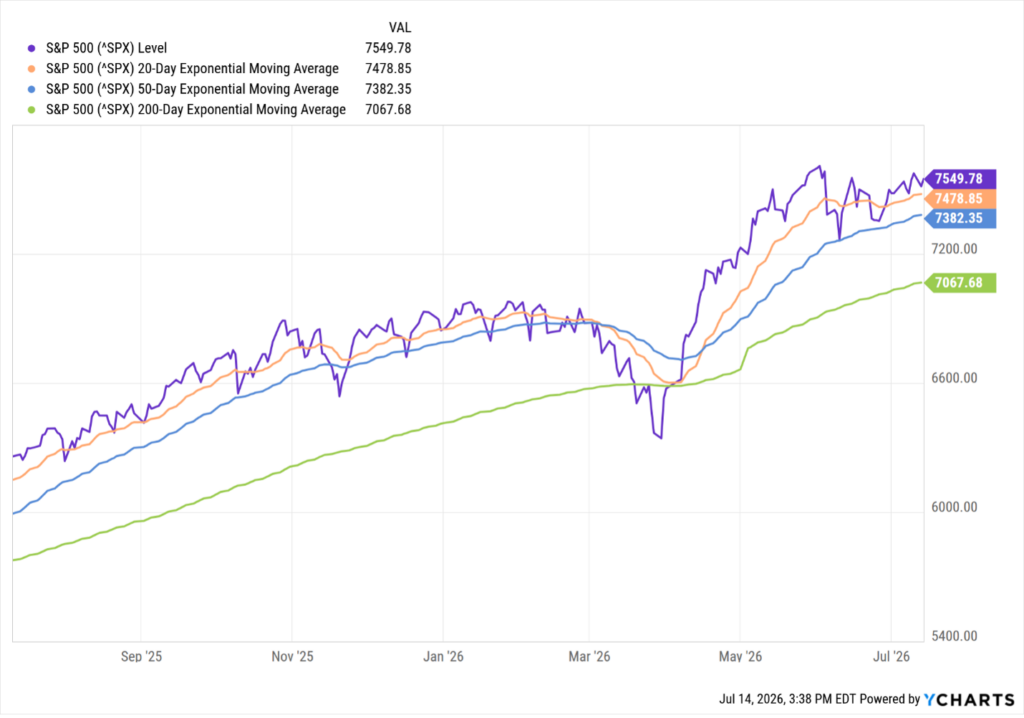
Since reaching a new all-time high on June 4, the S&P 500 has moved sideways in a relatively flat trading range. From a technical perspective, the index remains stable and continues to trade above its 20-, 50-, and 200-day moving averages (DMAs). It also maintains a 6.5% cushion above its 200 DMA. So far this quarter, the market has not experienced enough consecutive selling days to seriously approach this important long-term support level.
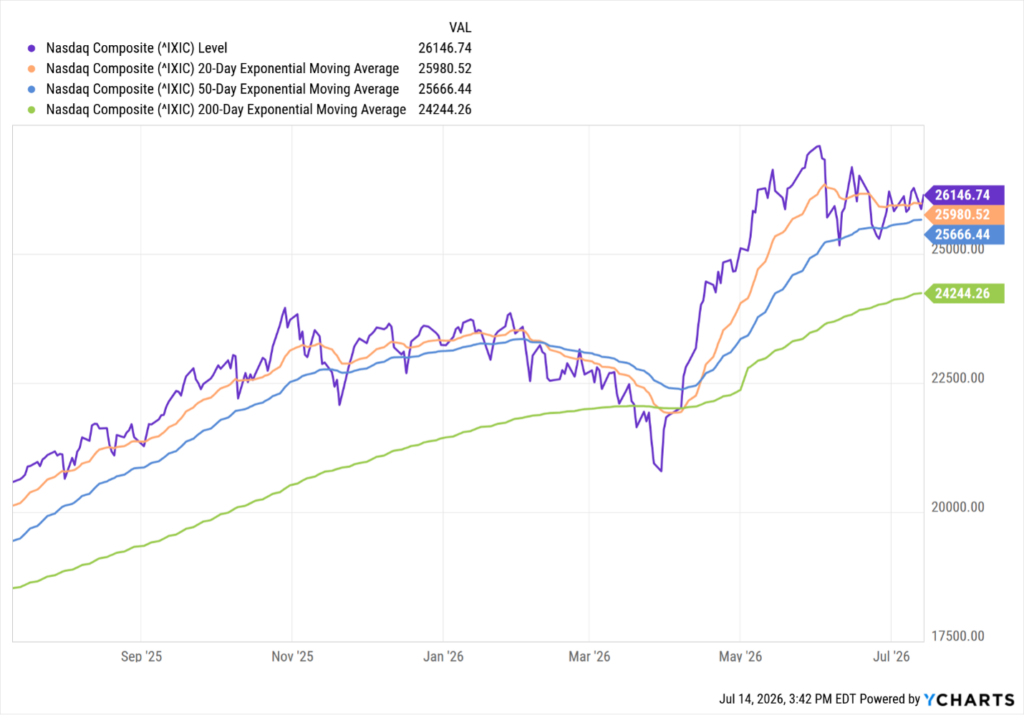
The technology sector has experienced somewhat greater volatility, particularly among high-growth semiconductors, AI, and chip companies. Nevertheless, the technology index remains 7.3% above its 200 DMA. Despite several large swings in chip stocks, the index has fallen below its 50 DMA only twice since June 4, once for a single day and once for a five-day period.
Headline news often appears to have a greater influence on investors during the third quarter, even when the underlying issues are not new. My theory is that during the summer months many institutional portfolios are being managed by the “B” team while senior portfolio managers leave for vacation. I can almost hear the departing senior managers telling the ‘B’ team on their way out, ‘Don’t ruin my portfolio!’
As a result, I believe the “B” team may react more defensively to negative headlines, repositioning portfolios to protect against a possible market selloff and perhaps to protect their jobs.
As summer winds down, the freshly tanned and rested “A” team returns and regains control of the portfolios. Renewed optimism about fourth-quarter earnings and the holiday shopping season often helps restore a more positive market trend.
For now, the principal third-quarter headlines influencing investors include the Iran war, oil prices, inflation, and interest rates.
Let’s examine each of these important topics.
IRAN WAR
Institutional investors have seemingly maintained only a modest level of concern about the war. When President Trump initiated attacks on Iran on February 28, investors aggressively reduced their stock exposure, contributing to declines across the major indices during March.
By April 7, however, investor concerns about the war and potential supply disruptions in the Strait of Hormuz had begun to fade. Attention shifted back toward the strength of the U.S. economy and the attractive buying opportunities created by the selloff among high-growth companies.
OIL PRICES
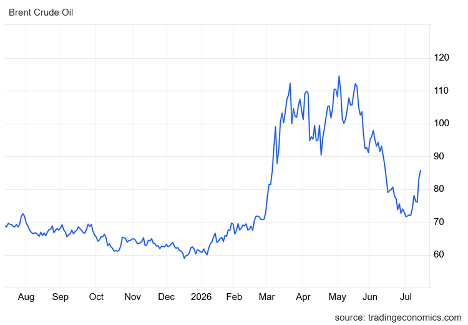
January 2026 marked the beginning of a significant increase in oil prices following several years in which Brent crude generally traded between $60 and $70 per barrel. When President Trump launched missile attacks against Iran on February 28, commodity traders feared substantial disruptions to global oil supplies.
As a result, Brent crude soared above $112 per barrel by March 20 and reached a peak of approximately $114 on May 4. Since then, trading activity has suggested growing confidence that the conflict will eventually be resolved, and global oil supplies will return toward prewar levels.
Despite the continuing uncertainty surrounding the Strait of Hormuz, one of the world’s most important oil-shipping routes, commodity traders have not consistently priced in a prolonged or severe supply disruption. Brent crude fell sharply to approximately $71 per barrel by July 2 before rebounding to close today at $85.55, reflecting renewed, albeit mild, concerns about Iran.
INFLATION
The Bureau of Labor Statistics released its Consumer Price Index report today. The largest factor this year in US inflation has been energy and fuel prices. The recent decline in oil prices has had a favorable impact on consumer prices. Trading Economics offered this observation of today’s report:
“The annual inflation rate in the US fell to 3.5% in June, the first decline in five months, compared to 4.2% in May and below forecasts of 3.8%. Energy costs increased 15.7%, below 23.5% in May, as the ceasefire between the US and Iran alleviated inflationary pressures from the energy component. Gasoline prices rose 26.7% (vs 40.5% in May) and fuel oil increased 42.9% (vs 58.9%). Inflation also slowed for shelter (3.3% vs 3.4%) and food (3% vs 3.1%).”
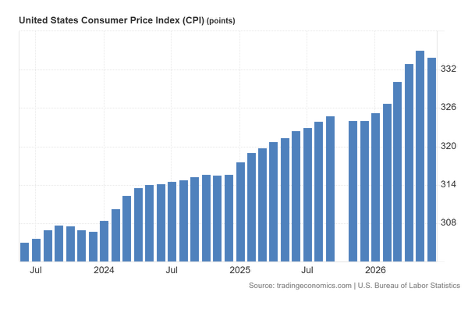
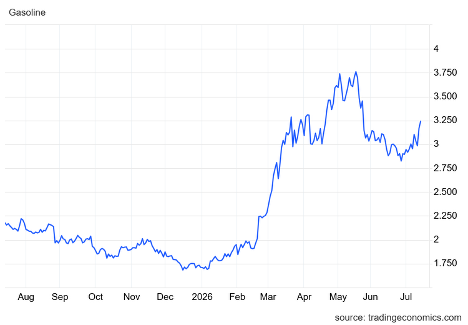
National gas prices at the pump followed Brent crude higher earlier this year and were a key factor in the rise of the CPI. Since gas prices at the pump dropped to $2.81/gallon on June 26, prices have risen to today’s closing national average of $3.23/gallon.
INTEREST RATES
Kevin Warsh, the new chairman of the Federal Reserve, is not making it easy for investors to anticipate the future direction of interest rates. After nearly two decades in which Federal Reserve chairs provided relatively candid guidance during congressional hearings about the Federal Open Market Committee’s (FOMC) interest-rate outlook, Chairman Warsh has explicitly stated that he does not intend to offer similar forecasts.
For reference, Ben Bernanke, Federal Reserve chairman from 2006 to 2014, believed more communication was needed by the FOMC. For decades, prior Fed chairs generally followed a policy of limited public communication. Bernanke changed that approach because he believed clearer communication would help investors, businesses, and the public better understand and support the FOMC’s objectives and likely policy direction.
On March 1, 2013, Bernanke spoke at the Annual Monetary/Macroeconomics Conference while the economy was still recovering from the devastating 2008 Great Recession. During his remarks, he outlined the FOMC’s multipoint strategy for stabilizing interest rates, supporting the economy, and controlling inflation. His third point emphasized the value of clearer Federal Reserve communication:
“Third, our approach to communicating and implementing monetary policy provides the Federal Reserve with new tools that could potentially be used to mitigate the risk of sharp increases in interest rates. In 1994–the period discussed earlier in which sharp increases in interest rates strained financial markets–the FOMC’s communication tools were very limited; indeed, it had just begun issuing public statements following policy moves. By contrast, in recent years, the Federal Reserve has provided a great deal of additional information about its expectations for the path of the economy and the stance of monetary policy. Most recently, as I mentioned, the FOMC announced unemployment and inflation thresholds characterizing conditions that will guide the timing of the first increase in the target for the federal funds rate. Further, the FOMC stated that a highly accommodative stance of monetary policy is likely to remain appropriate for a considerable time after our current asset purchase program ends. By providing greater clarity concerning the likely course of the federal funds rate, FOMC communication should both make policy more effective and reduce the risk that market misperceptions of the Committee’s intentions would lead to unnecessary interest rate volatility.”
Chairman Warsh appears to be returning the Federal Reserve to its pre-Bernanke limited communication policies, leaving investors with less guidance about the future direction of interest rates. He believes public comments by FOMC members can artificially influence the bond and lending markets, including residential mortgage rates.
Earlier this year, investors anticipated as many as three FOMC rate increases during 2026. Analysts now reportedly estimate a 86% probability that the Federal Reserve will leave interest rates unchanged for the remainder of the year.
Today’s favorable Consumer Price Index report may provide additional evidence that further rate increases will not be necessary to slow inflation.
What does this mean to me?
Investors have demonstrated remarkable patience this year despite numerous economic and geopolitical challenges, including the war in Iran, the sharp rise in oil and gasoline prices, and a leadership transition at the Federal Reserve.
Investors started the year with mounting economic and geopolitical concerns. The first quarter negative trend gained momentum with February 28 bombings. However, on April 7, investors appeared to be experiencing a renewed sense of FOMO (fear of missing out) as semiconductors, AI, and chip stocks reached attractive valuations following the previous 37-day market selloff.
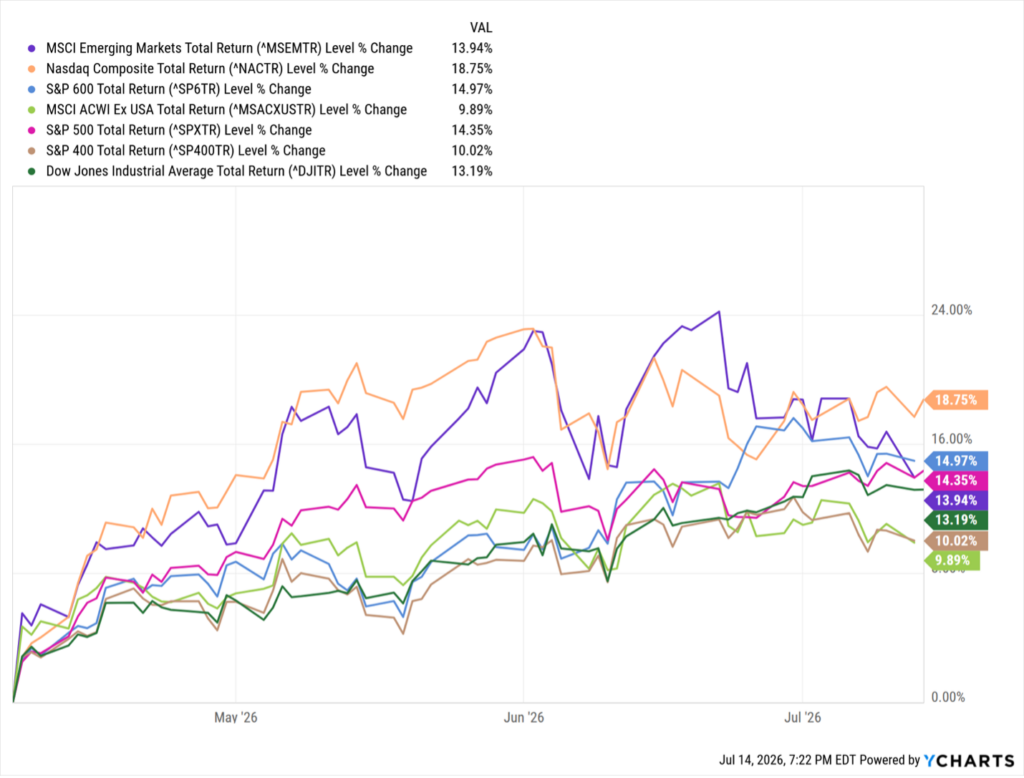
Equity markets subsequently surged, with strong gains both domestically and internationally. The rally lifted the Nasdaq Composite to a 18.75% total return since April 7, the strongest gain among the major indices. Emerging markets followed closely, with the MSCI Emerging Markets index returning 13.94% over the same period, edging out both the S&P 500 at 14.35% and the S&P 600 small-cap index at 14.97%. The chart below illustrates the total return performance of the major market indices from April 7, 2026 through yesterday.
However, despite the significant gains since April 7, the performance and leadership of these indices differ when considering their YTD total returns. For the year, the best performing US index is the S&P 600 Small Cap index up 21.1%. This comes after decades of trailing the S&P 500 and NASDAQ, which have YTD gains of 10.48% and 11.68% respectively.
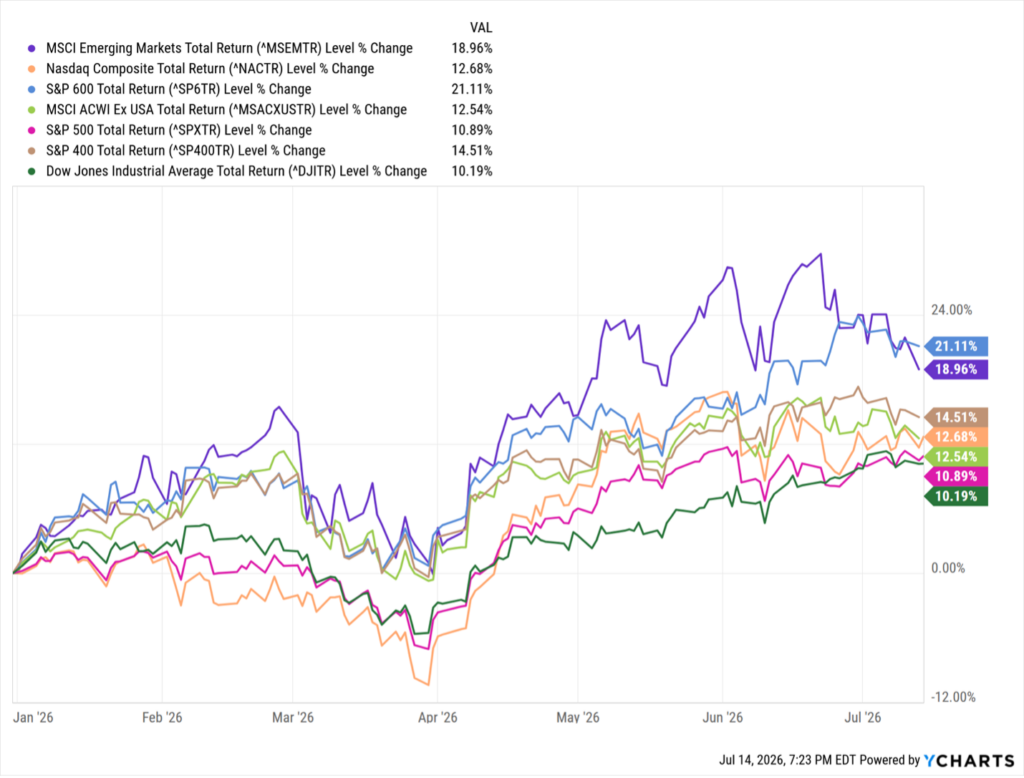
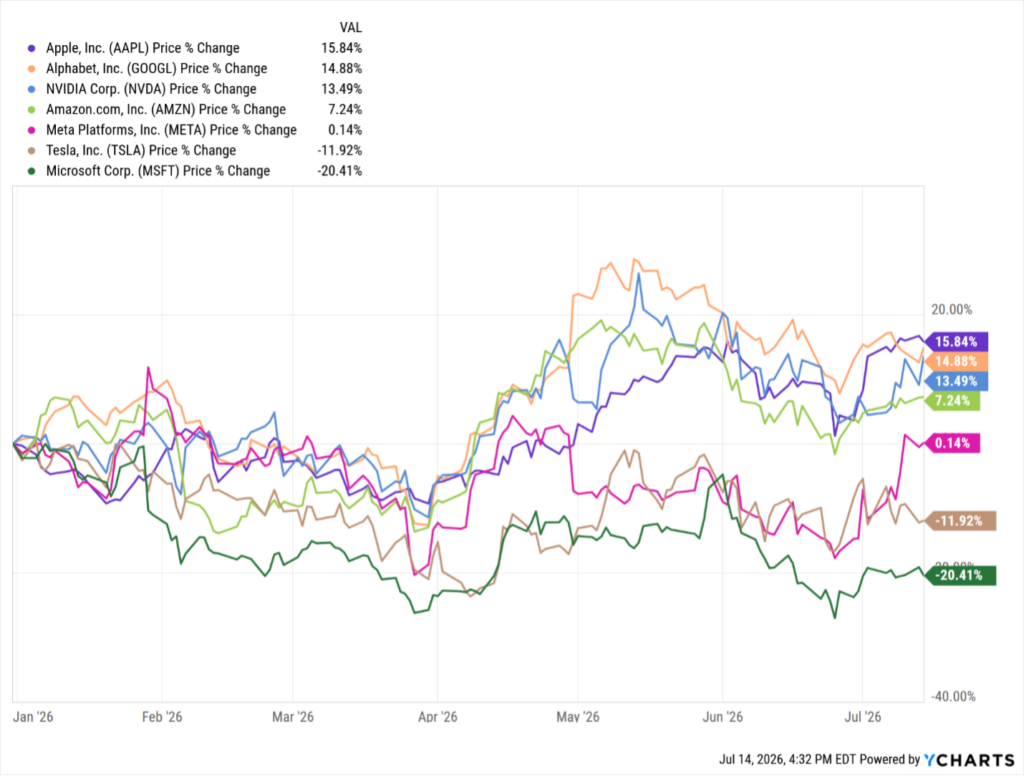
The NASDAQ, last year’s tech-driven leader, is falling behind as investors diversify into more attractively priced foreign, small-cap, and mid-cap stocks. One factor in the NASDAQ’s underperformance is the impact of the dominant and well-known ‘Magnificent 7’ stocks (Apple, Alphabet, Nvidia, Amazon, Meta, Tesla, and Microsoft). These seven stocks carry heavy weight in the NASDAQ and are lagging, with two of the seven posting negative YTD returns. In this group, Microsoft and Tesla lead the race to the bottom down -20.4% and -11.92% respectively YTD.
The third quarter may offer another summer sale, this time on high-growth leaders in the tech sector. A good indication of a developing buying opportunity is stock prices remaining weak through the third quarter while earnings reports and forecasts remain favorable. July will be packed with companies reporting on their second quarter earnings with forecasts for the balance of this year. Investors will be paying close attention to these forecasts to determine future stock price projections. If the third quarter fulfills its historical track record of weakness, the third quarter may be another summer sale event for investors.
Up Capital Management is an SEC-registered investment adviser. Registration does not imply a certain level of skill or training. This commentary is for informational purposes only, reflects the opinions of the author as of the date shown, and is not investment, tax, or legal advice or a recommendation to buy or sell any security. Up Capital Management and its clients may hold positions in the securities discussed. Index and market data are drawn from sources believed reliable but are not guaranteed for accuracy or completeness; indices are unmanaged, cannot be invested in directly, and do not reflect fees or expenses. Past performance is not indicative of future results, and all investing involves risk, including the possible loss of principal.