

The Stagnant Housing Market of 2025
Weekly BriefAugust 27, 2025•5 min read
After the Federal Reserve raised its discount rate 500% in 2022 and 2023, taking mortgage rates up with it, housing activity has hit a brick wall. Since mid-2023, prospective home buyers have remained on the sidelines, happy to remain with their current home or as renters.
When the pandemic hit the world in 2020, mortgage interest rates plummeted to historic lows as the Federal Reserve tried to stabilize the US economy. This was fortuitous for those who took advantage of ultra-low mortgage rates that fueled a housing boom that included those migrating from their city digs to the country. However, now that rates are stubbornly holding in the mid-6% range, the cost of owning a home has nearly doubled. It makes sense why many are choosing to stay as renters. Tax benefits are similar for renters as owners, and when the sprinklers are not working or the toilet is backed up, it’s the owner’s responsibility to get it fixed.
This would explain why home ownership continues to decline. As reported by the US Census Bureau, home ownership decreased to 65.1% of all homes in the first quarter of 2025.
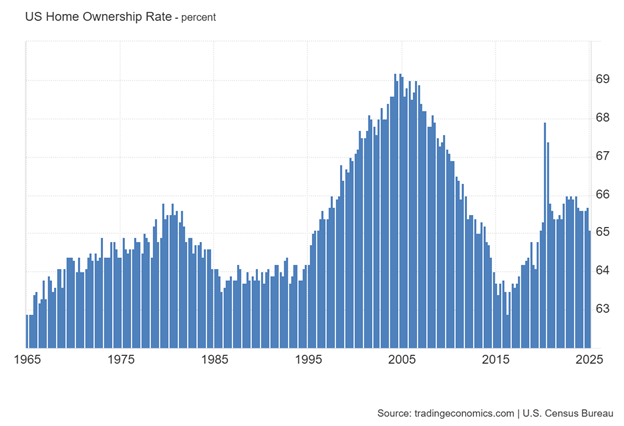
The biggest change in home ownership occurred during the period from 1995 to 2015. The entire cycle lasted over 20 years, with the peak in home ownership peaking in 2004 at 69.2% to the lowest recorded percentage of 62.9% in the second quarter of 2015 (same percentage of home ownership in 1965).
However, with the apparent backlog of would-be buyers and sellers, a reduction in mortgage rates may initiate a greater volume of activity this year-end or into the spring of 2026. Even though investors are anticipating the Federal Reserve lowering rates next month, it is worth remembering that when they reduced their discount rate twice in late 2024, mortgage rates didn’t change, and in some areas actually increased. So, it remains to be seen if mortgage rates follow the Federal Reserve’s lead this time with lower rates.
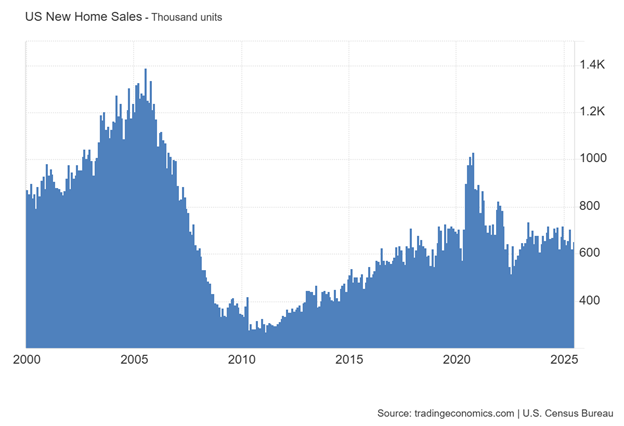
For now, home sales have remained stagnant. Monthly new home sales have barely changed since April 2023. Trading Economics commented on the following on the recent report by the US Bureau on new home sales:
-
“Regionally, sales fell sharply in the Midwest (-6.6% to 85,000) and the South (-3.5% to 388,000), offsetting growth in the West (11.7% to 153,000). In turn, new home sales remained unchanged in the Northeast (at 26,000). In the meantime, the number of unsold homes on the market also fell by 0.6% to 499,000, equivalent to 9.2 months of inventory at the latest sales pace. The median sales price was $403,800, 0.8% below the price from the last month.”
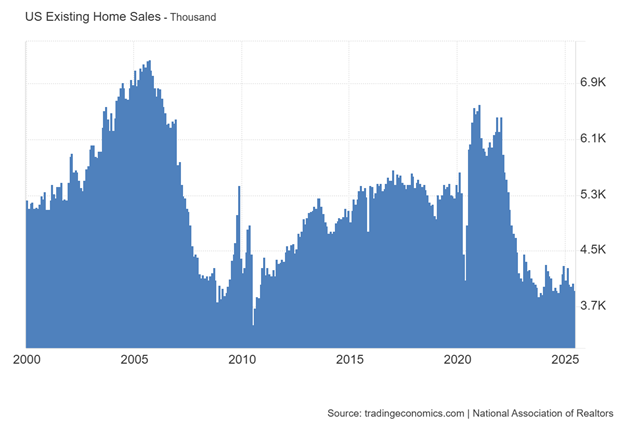
Unbelievably, existing home sales in 2025 are nearly at the lowest volume in recorded history, with only 4.01 million homes sold on an annualized basis in July. This is the same annualized rate of homes sold in July 2023 and below the number of homes sold in 2020. In fact, you would have to go back to the Great Recession for a period of lower volume of home sales with the lowest annualized rate of home sales in history, which occurred in July 2010, of 3.45 million.
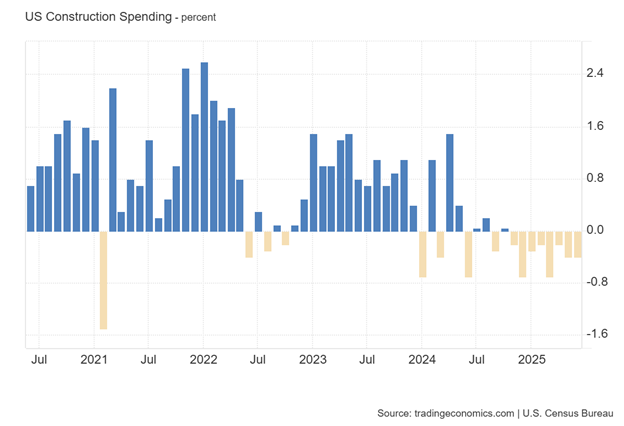
Average national home prices understandably have stagnated with the low volume of new and existing home sales. Prices decline when sellers must sell, and listing prices start getting lowered. However, millions of buyers took advantage of low interest rates at the start of this decade, and now many cannot afford the mortgage for their own home with current interest rates. Developers have smartly made aggressive cuts to new developments, with eight consecutive monthly declines in new construction spending since November 2024. As a result, many developers are not in the awkward situation of drastically reducing prices, even at potential losses, to avoid the carrying costs of owning empty houses.
What Does This Mean to Me?
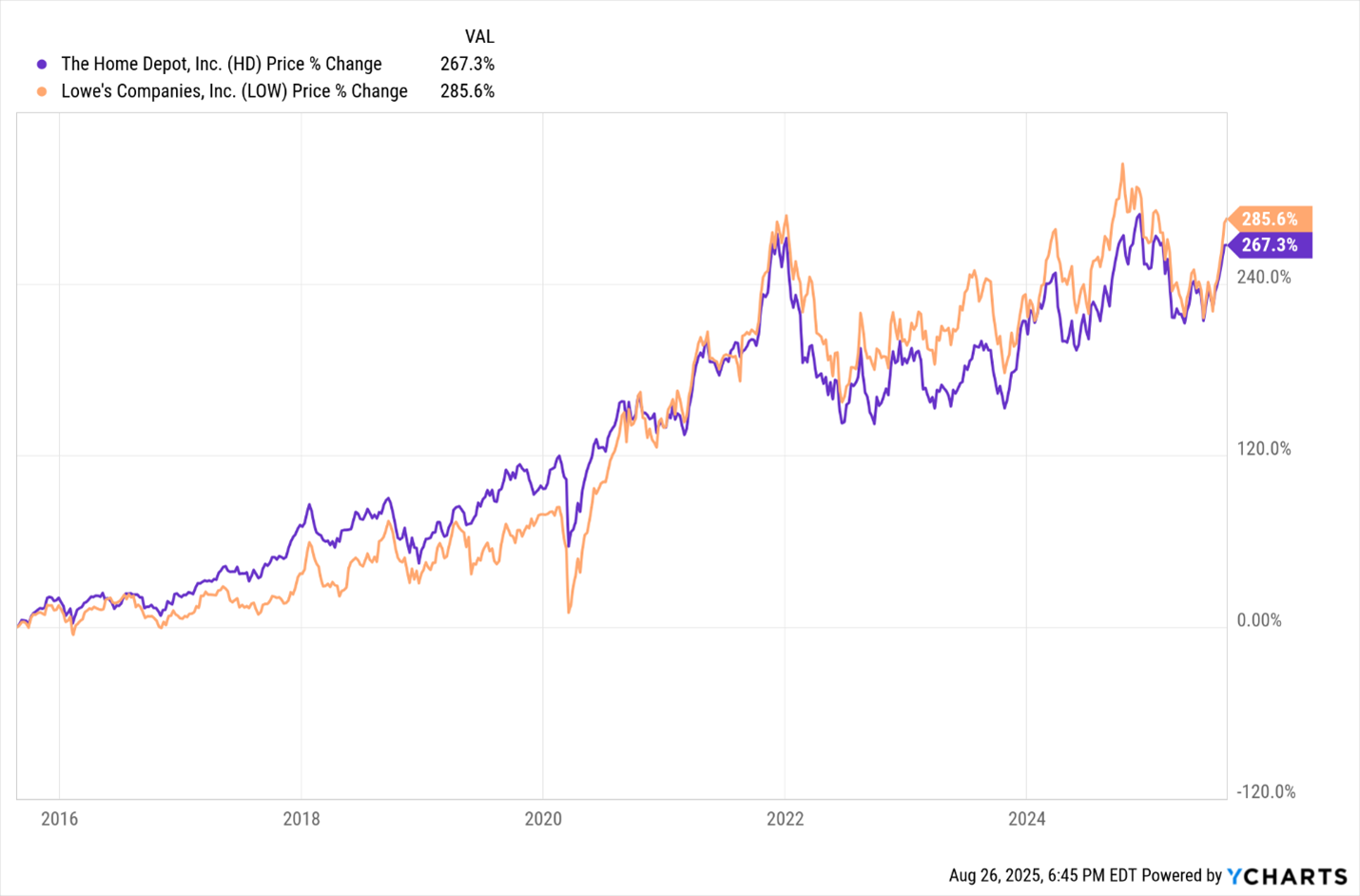
As we have mentioned, consumer spending represents 66% of the US economy. The largest expenditure item for consumers is typically for their home. As a result, all businesses dependent on the residential market are struggling, from mortgage brokers to national suppliers. Stocks for Home Depot and Lowe’s are trading at nearly the same price as they did when they peaked in December 2021.
This may also be a factor in consumer sentiment that the University of Michigan reported is at historic lows. Consumer sentiment is partially impacted by their sense of wealth, which has been challenged this year. Consumers’ 401 (k) accounts have been fluctuating wildly in value this year, coupled with stagnant or declining home prices. If consumer sentiment does not improve in the next few months, the potential for another record holiday retail season may be in jeopardy. The Federal Reserve may save the holiday sales by lowering its discount rate as jubilant investors spend on gifts with their rising stock portfolios, but it may not improve the status of the housing market.
However, lowering the Discount Rate may prompt mortgage lenders to start lowering mortgage rates in 2025 and into 2026, which may have post-Christmas blessings for the housing market in the spring of 2026.
Institutional investors continue to add to their stock holdings as the S&P 500 and NASDAQ indices continue closing at new highs. We maintain our favorable outlook for the US economy and stock market.
Let us know if you have any questions about this UPdate or your own financial planning. We welcome the opportunity to help you and your family.

Anton Bayer
Back to Blog