
Today, I received a message from a long-time client. The message was short and direct:
“I’m up 1,200% and wondering what the top is?”
My client was referring to a single stock position and concerned about the increasing risks of a potential selloff.
Over the past 25 years, our Growth and Growth & Income Model Portfolios have occasionally held companies that experienced extraordinary multi-year advances fueled by exceptional revenue growth, expanding profits, and strong institutional investor demand. A few notable examples include Apple, Home Depot, Netflix, Chipotle, Michael Kors, and Gap Stores. While each company’s story was unique, they shared common characteristics: strong business execution, growing earnings, and increasing institutional support.
Large gains often create a difficult emotional dilemma for investors. On one hand, there is excitement and euphoria from seeing an investment perform far beyond expectations. On the other hand, there is the growing fear that the gains could quickly disappear. Experienced investors understand that stocks capable of producing extraordinary returns can also experience significant and sometimes unpredictable declines along the way.
Determining when a stock has reached its ultimate peak is impossible to know in real time. Instead, successful investors focus on monitoring the underlying business fundamentals, earnings trends, revenue growth, and institutional support. As long as these factors remain favorable, a winning investment may continue to surprise investors with how far it can climb. Conversely, when those trends begin to deteriorate, it may be time to reassess the position regardless of past performance.
The reality is that few investors ever sell at the exact top, just as few buy at the exact bottom. Long-term investment success is not achieved by perfectly timing every trade. It is achieved by identifying sustainable growth opportunities, managing risk appropriately, and allowing compounding to work overtime. While protecting profits is important, prematurely selling a great company can sometimes be just as costly as holding a deteriorating one for too long.
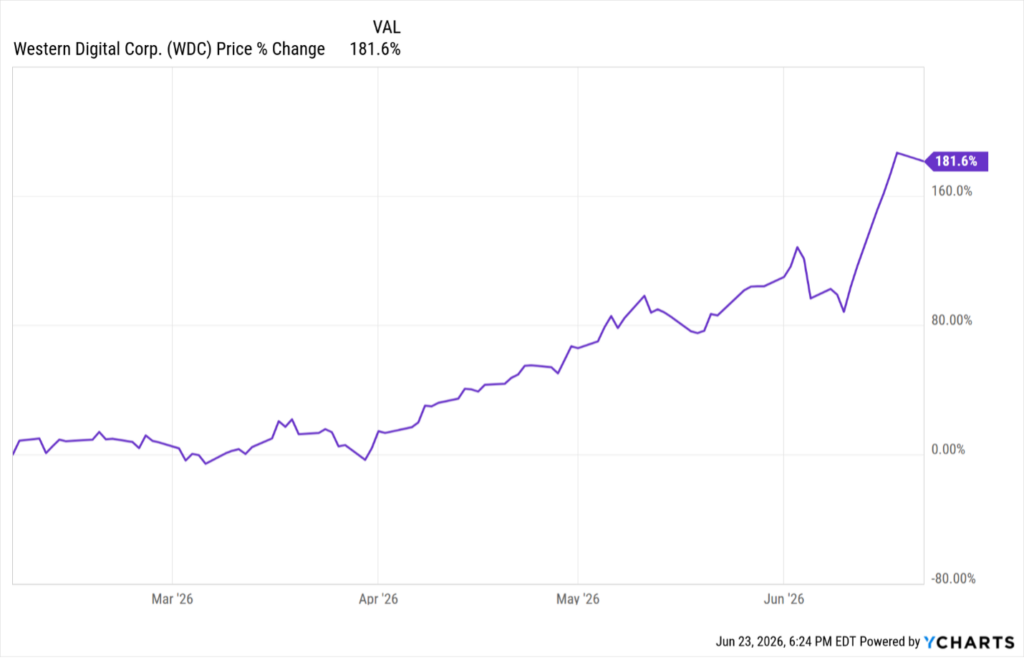
Technology companies, particularly those benefiting from the rapid adoption of artificial intelligence, are experiencing one of the most powerful growth cycles in recent history. Earlier this year, we began adding Western Digital (WDC) to our model portfolios. By yesterday’s close, the stock had appreciated approximately 182% since our initial purchases in early February 2026.
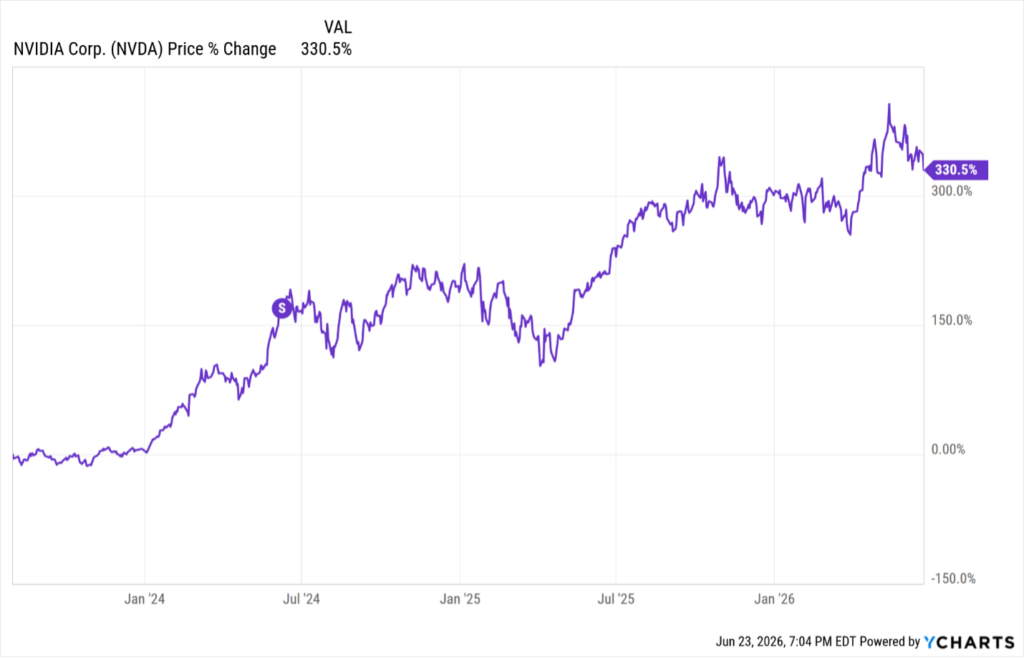
Another example is Nvidia (NVDA). We began building positions in NVDA during August 2023 at approximately $49 per share on a split-adjusted basis. On June 10, 2024, Nvidia completed a 10-for-1 stock split and continued its remarkable advance, closing yesterday at $200.04 per share. Despite a valuation of $4.89 trillion (yes, trillion) and a forward price to earnings ratio of 34, modestly above the S&P 500’s 22, the company may still have meaningful room to grow.
The question my client was really asking was not, “What is the top?” but rather, “When do I sell?”
The reality is that few investors consistently identify the exact peak of a stock’s advance. The challenge is balancing the desire to protect gains while allowing successful investments the opportunity to continue compounding over time. As long as the underlying business fundamentals remain intact, quarterly earnings continue to grow, and institutional investors maintain strong support for the stock, we generally see little reason to exit a winning position solely because it has risen substantially in value.
Successful investing requires ongoing monitoring of several key indicators, including earnings reports, management guidance, analyst revisions, institutional buying activity, and overall price and volume trends. Equally important is monitoring competitors within the company’s industry. If competing companies begin reporting slowing revenue growth, declining profit margins, or weakening demand, those developments may provide early warnings that could eventually affect the companies we own.
One of the most common mistakes investors make is becoming emotionally attached to a stock due to its outstanding performance (not to mention bragging rights). When this occurs, investors often become blind to deteriorating fundamentals and ignore emerging sell signals. Confirmation bias can reinforce this behavior as investors focus exclusively on positive news and optimistic forecasts while dismissing signs of technical or fundamental weakness. The result is often holding a position too long and watching substantial gains gradually disappear.
Successful investing requires discipline. We strive to remain objective, allowing the facts, earnings trends, institutional behavior, and market action to guide our decisions rather than emotions. While no strategy is perfect, maintaining that discipline can help investors avoid turning a successful investment into a shouda, coulda, sad story.
What does this mean to me?
Building wealth involves much more than selecting successful investments. Even though a 1200% gain is very exciting, having a well-defined financial plan that establishes your goals, timeline, and target investment returns is equally important (although maybe not as exciting). A thoughtful financial plan can help identify reasonable annual growth targets, projected end of year account balances, and the minimum rates of return necessary to achieve your long-term objectives. Just as importantly, it can help determine the appropriate level of risk to assume and when it may be prudent to reduce that risk.
For investors approaching retirement or already taking distributions from their portfolios, maintaining adequate liquidity becomes increasingly important. One strategy may be to take some profits of your best performing stocks and allocate a portion of the portfolio to more conservative investments designed to fund one or more years of anticipated withdrawals. This approach can help provide stability during periods of market volatility and reduce the likelihood of being forced to sell growth-oriented investments during a market decline. Too many times investors have regretted holding a stock too long only to watch their once profitable stock position decline back to their original buying price.
Market corrections and bear markets are a normal part of investing. Historically, financially strong companies with growing earnings have often recovered and gone on to achieve new highs as investors recognize renewed opportunities. One key is having a plan that allows you to have the patience and liquidity necessary to weather inevitable market downturns while remaining positioned to participate in the next growth cycle. The second key is recognizing declining company or industry fundamentals that may result in an extended selloff such as dot.com bust of 2000 to 2003.
Successful investing is not about predicting every market move or selling at the exact top. It is about aligning your investment strategy with your financial goals, managing risk appropriately, and maintaining the discipline to stay focused on the long-term plan.
Get started here if you have any questions about this UPdate. We welcome the opportunity to assist you and your family in developing a financial strategy to achieve all your goals.
IMPORTANT DISCLAIMER: The securities mentioned above are examples for illustration only. They do not represent all holdings in our model portfolios and should not be considered a recommendation to buy or sell any security. Not all positions in our model portfolios have performed as the positions described, and some holdings have produced losses. Past performance is not indicative of future results.