

Freedom is the Secret Sauce of America
Weekly BriefJanuary 21, 2025•5 min read
We have mentioned in past UPdates the importance of monitoring the financial health and sentiment of US consumers. The primary reason is that American spending represents a whopping 67.9% of America’s Gross Domestic Product (GDP) otherwise known as gross revenue from all transactions (illustrated below by JP Morgan). Embedded in the matrix of consumer spending are the freedoms Americans have that have always been the foundation of the world-dominant US economy.
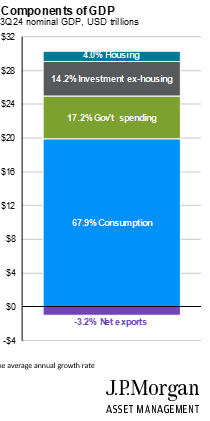
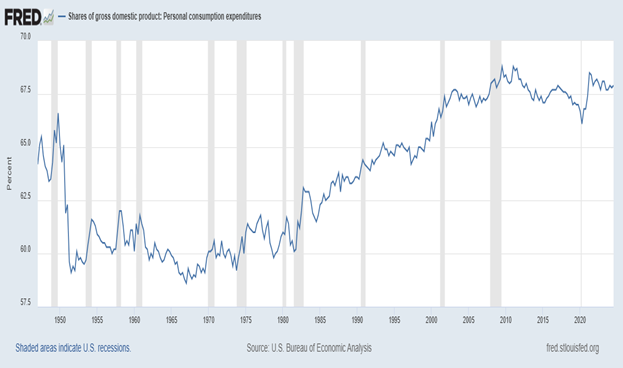
Most impressive is that the consumption percentage by consumers of the nation’s GDP has not materially changed since 1981.
Below is a chart by the Federal Reserve Bank of St Louis, of the percentage of consumer consumption to GDP since 1947, during the late 1940 consumer spending represented 63% to 66% of the nation’s GDP. This ratio dropped significantly between 1951 and 1981. Then starting in 1981, consumer spending as a percentage of GDP surpassed its former high reached in 1950 and has steadily increased to the highest levels since the Federal Reserve Bank of St Louis began its tracking.
There are several key points to learn from this information.
First, this phenomenon of consumer spending being such a dominant factor in the US economy is a key to its stability and growth. The simple reason is that consumer spending is the result of hundreds of millions of people spending as they want with no restrictions other than their financial capabilities on what and when they want to shop. Should people want to start a business or excel in their employer’s business to earn more to spend more, there are minimal government regulations to limit these aspirations. Most importantly, at no time in history has the US economy not recovered from a recession or worse even the Great Depression (1930 to 1945) and Great Recession (2008 to 2009). In all cases, the US economy recovered and expanded to greater levels than previously reached.
No single entity, organization, or government can unilaterally undermine the US economy. It would take a coordinated effort of millions of people to significantly impact the economic health of the economy. Therefore, if consumers’ financials and employment are stable or improving, so will the US economy.
Second, you will notice my focus on America’s economy. America now has the longest duration period operating by a codified original Constitution. This founding document was created on the principles of a free market economy with an independent society. All 194 other countries in the world do not have a track record of a constitution for a duration all have variations of limited free market economy, socialism, communism, or dictatorships. In all cases, the ruling party or government controls most of the country’s economy restricting the liberties of its citizens and business owners. The premise that societies other than free market societies improve the standard of living of their citizens has been proven false in every metric for thousands of years.
Side note: Some historians consider San Marcos (population 33,537) a country surrounded by Italy, with their Constitution dating back to 1600 as the longest continuous use document. However, the government never codified its constitution and even if it did, the country has fewer citizens than most small towns in the US. Refer to a very interesting report titled, “Oldest Constitutions in the World”.
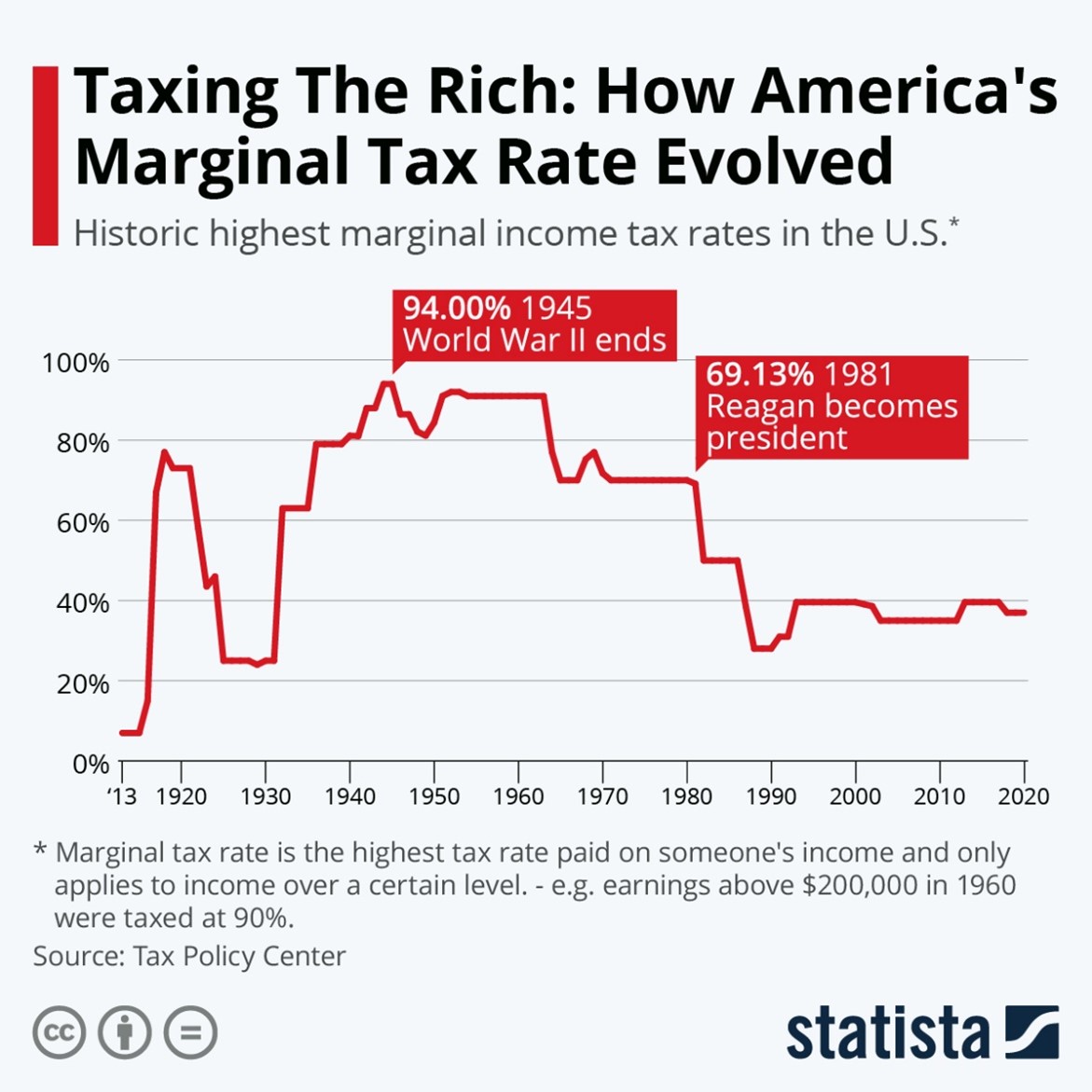
Third, the consumer consumption ratio to GDP is directly related to how much the US government taxes Americans. Below is a chart of the history of top US marginal tax rates. You will notice a direct correlation between the changing ratio of consumer spending to GDP with the changing of Federal marginal tax rates. The higher marginal tax rates the less Americans have to spend. The decline in consumer spending is not entirely offset by the increase in government tax revenue and subsequent spending. The decline in overall GDP typically leads to recessions. Worth noting is the longest bull market in history with the Dow Jones rising over 1000% (1982 to 2000), was also during a period that the top marginal tax rates were at levels not seen since the late 1920’s. Not surprisingly the lower marginal tax rates of the 1920s were also a period of strong economic growth so prosperous the decade was named the “Roaring 20’s”.
What Does This Mean to Me?
As mentioned, to determine the health and future of the US economy, we need to monitor the financial condition and emotional sentiment of consumers.
The financial status of US households continues to remain positive supported by more Americans working in the history of this country. American saving rates are at the higher historic average range largely due to millions of homeowners with sub 4% fixed mortgage rates.
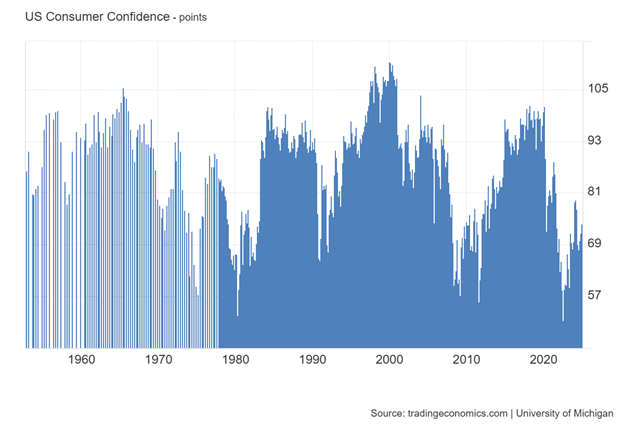
Ironically, Americans continue to report 2020 low positive sentiment on their finances and prospects of building wealth. In fact, as illustrated below, Americans are now more pessimistic than during the period of recessions in the early 1990s and the mid-1970s. More curious is in 2022 Consumer Confidence plummeted to the lowest levels ever recorded going back to 1950 which includes 2008 when the economy was at its most vulnerable state since the Great Depression.
We see this as an opportunity. If everything is at the top there is nowhere to go but down. How much consumers spend is a direct correlation to their sense of wealth and confidence. Rising consumer spending will increase the US GDP and corporate earnings. This is good news for investors. In summary, we maintain our favorable view of the US economy and stock market for 2025.
Let us know what you think. We welcome the chance to speak with you, read your comments, or have an opportunity to assist you with strategies to achieve your financial goals. Let us know how we can help you.

Anton Bayer
Back to Blog