

Case for Staying Invested
Weekly BriefMarch 12, 2025•5 min read
For the past week, major media outlets have opined on the stock market volatility speculating whether this is the beginning of a significant stock market selloff and if the US economy is entering a deep recession cycle like 2008 or 1929.
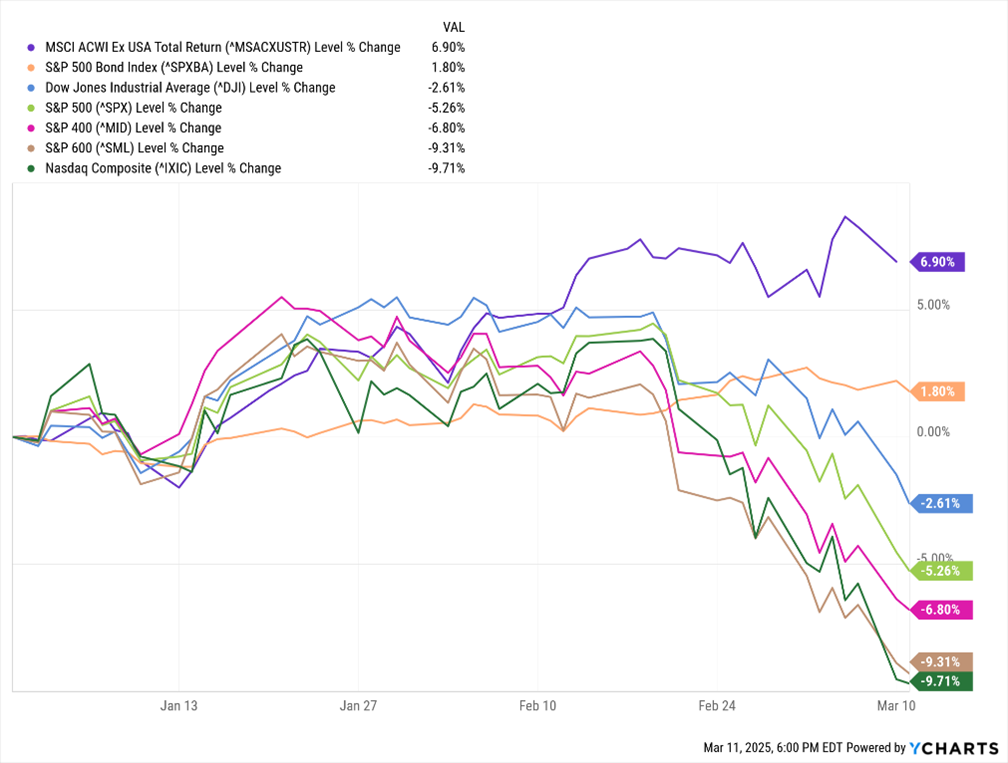
However, the media is overstating the damage to investor accounts. Year to date, the S&P 500 is down -5.26% and the Dow Jones Industrial Average (DJIA), the darling of the media because of the point fluctuation, is down YTD -2.61%. You are reading that correctly. The DJIA is down less than 3% for the year. The media loves to report the down days of the Dow Jones in points, like today’s front-page headlines of the Dow Jones down 980 points yesterday, which doesn’t sound as alarming when stated it was only down 2.10%.
So far this year, NASDAQ has the biggest decline of the major indices. The MSCI Ex US, a foreign index, is having its best year start in 25 years. Below are the YTD returns of the major indices through yesterday.
-
MSCI Ex US: 6.90%
-
S&P Bond: 1.80%
-
Dow Jones Industrial Average: -2.61%
-
S&P 500: -5.26%
-
S&P 400 Mid Cap: -6.80%
-
S&P 600 Small Cap: -9.31%
-
NASDAQ: -9.71%
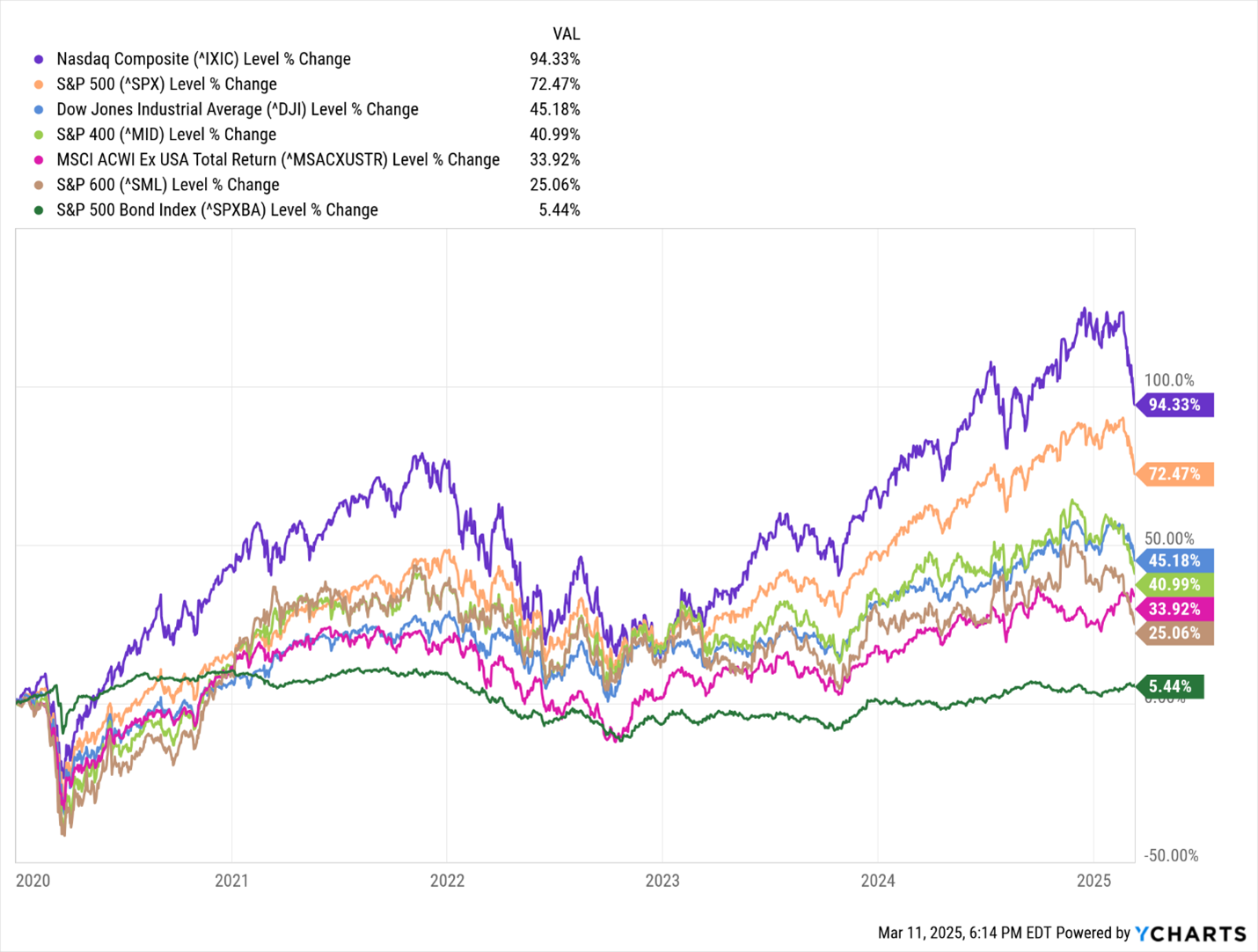
It seems the major media has forgotten the past two years in which the S&P 500 is up +55% and NASDAQ is +81%. More impressive is since 2020 through today, the S&P 500 is up 72.5% and NASDAQ is +94.3% including the volatile selloff in Q1 2020. I guess that is old news.
The impetus for most of the anxiety is President Trump’s extensive and ambitious goals that include reducing the Federal government size and budget, changing immigration policies, re-structuring energy policies, and re-balancing our foreign trade. Any one of these goals would have an impact on most business sectors in the US and abroad. However, the Trump administration has tackled nearly all his campaign initiatives since his inauguration. Investors do not respond well to change, and the stock market decline reflects investors’ nervousness.
Most recently, investors have been reducing their stock holdings waiting for clarity on President Trump’s tariff policies that have been changing almost daily. Investors are concerned about the possible trade war specifically with Mexico, Canada, and China and the impact on the US economy. Some analysts are projecting the potential of recession – seemingly a mild outcome compared to the more dire scenarios some pundits are floating.
Our view is that the US economy’s strength is not based on the federal government, tax law, or regulations. The strength of the US is based on the very diverse matrix of businesses with 99% of the businesses with less than 500 employees. The ability of one administration to wipe out millions of companies along with the incomes of hundreds of millions of employees seems extremely remote. That is not to say that bad governance and laws will curtail economic growth, as is the case in many cities in America that are now experiencing high crime, corporate exodus, population declines, and rising deficits.
Historically, during good economies as we are now, the stock market will advance 66% of the time and 33% of the time consolidate. The narrative why the stock market declines in growth cycles is sometimes irrelevant other than it creates a rationale to why investors are selling. The reality is that after having significant gains, institutional managers rebalance their portfolios to take profits and establish new entry points.
The more important data is that staying invested in growth economies and riding out market down cycles is a successful proven strategy. In fact, volatility adds profits to investors who take advantage of buying stocks of companies with strong earnings growth.
Jeffrey Buchbinder, Chief Financial Officer of LPL Financial, reported today that the probability of stock market gains since 1950 is 74% for rolling one year periods and 85% for rolling three year periods. That’s very remarkable when considering your chances of winning at a casino with 98% payouts is zero.
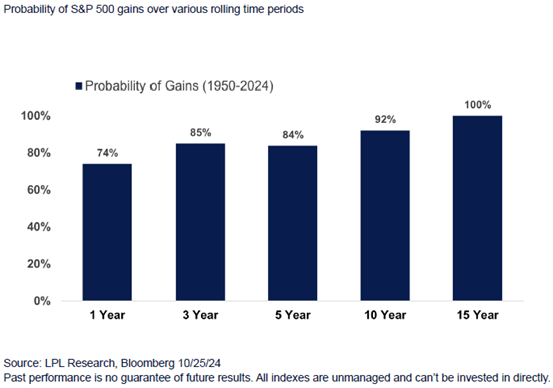
Another fact Mr. Buchbinder pointed out is:
-
The S&P 500 has gained an average of 9.8% since 1990. If you miss the best day each year, your return drops to 6.1%. Miss the best two days, and you’re better off sticking with bonds — your average gain drops to just 3%.
Currently, the S&P 500 is down -9.31% since reaching an all-time high on February 19, 2025. The index has crossed below its 20, 50, 200 Day Moving Average (DMA).
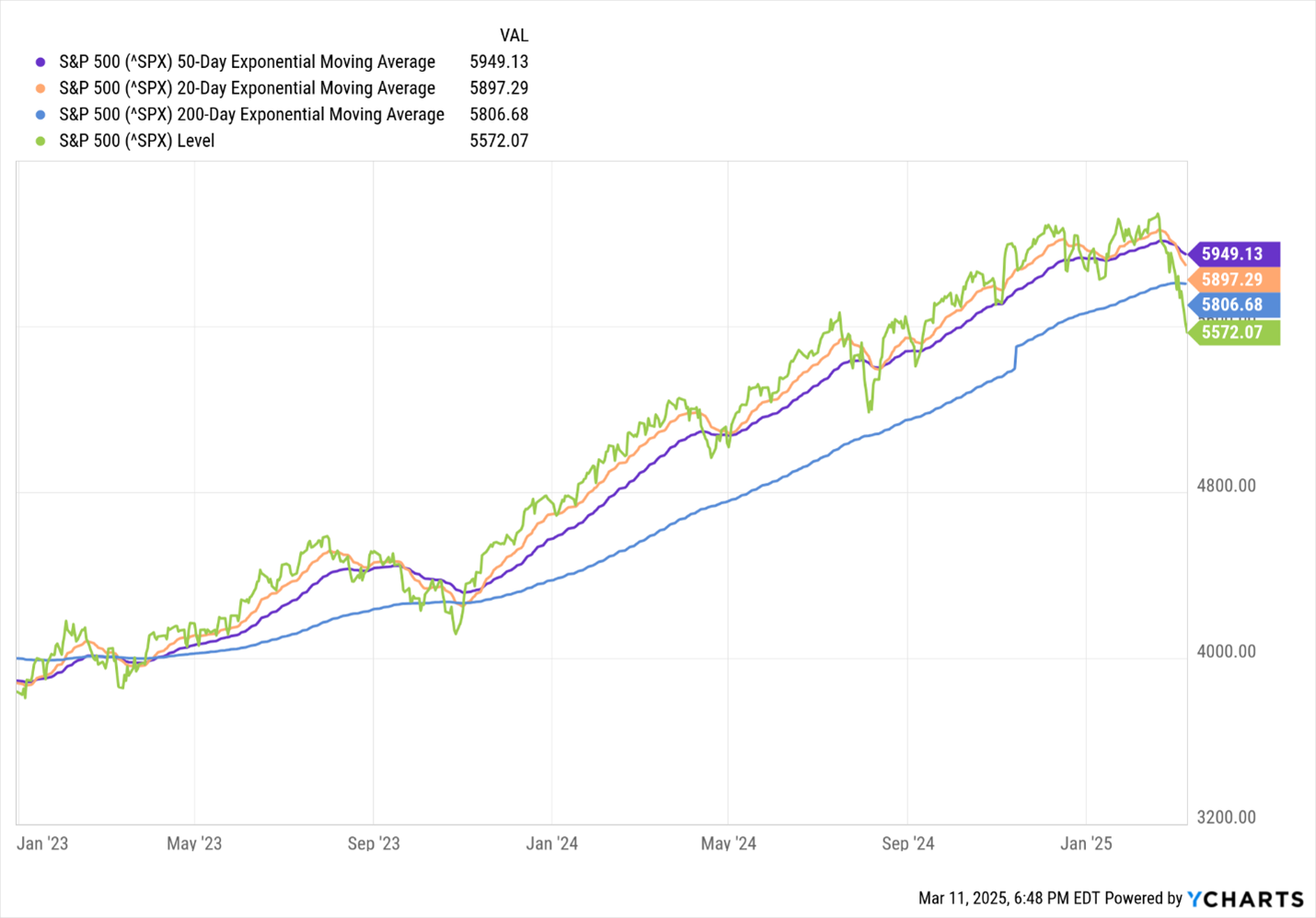
Mr. Buchbinder noted that:
-
Historically (since 1980), after corrections, the S&P 500 has been higher by an average of 13.1% three months later, with gains 92% of the time. That’s from the low which, of course, is only apparent in hindsight, but it speaks to the potential upside of putting new money to work after corrections occur.
What Does This Mean to Me?
Although investors are nervous about the new administration and how they are implementing new policies, the US economy remains strong with more people working in the history of our country. That said, there are realistic near-term concerns about the impact of these new policies on the US economy and stock market. We are monitoring the markets domestically and abroad to determine the best strategy to navigate through this year. At this time, our view is to be patient and wait for the next bounce. If at that time you want to rebalance and reduce risk that would be the time to make some adjustments.
Give us a call if you have any questions about your account, especially during these last volatile weeks.

Anton Bayer
Back to Blog