
Last week, in our Update titled “Concentration Built It, Diversification Keeps It,” we discussed some of the difficult lessons investors learned when the dot-com era came crashing down in the early 2000s.
During the 1990s, many investors accumulated significant wealth through the exceptional performance of a single stock or asset class. In many cases, this concentration resulted from ownership of company stock acquired through stock options, employee stock purchase plans, or retirement plan investments. After enjoying years of above-market returns, investors often became complacent and lost sight of the risks associated with holding a substantial percentage of their wealth in one company or asset class.
We wrote:
“Concentrating wealth in one or a few assets creates the potential for both exceptional returns and substantial losses. During a strong growth cycle, a concentrated investment can soar in value and dramatically accelerate wealth creation. However, if conditions change, that same concentration can expose an investor to devastating losses.
Concentration can be an effective strategy for building wealth, but diversification becomes increasingly important for protecting it.”
For many investors during the 1990s, creating a highly concentrated portfolio was never intentional. A stock that initially represented only a small percentage of an account may have appreciated so dramatically that it eventually became the majority of the portfolio’s value.
At Up Capital Management, we have encountered this same situation many times during the past 20 years while managing model portfolios across three risk categories. The core of our models consists primarily of allocations to index-based exchange-traded funds (ETFs) or mutual funds, supplemented by a limited number of individual stocks that we believe have the potential to outperform the model’s benchmark.
Over the years, we have owned several stocks that experienced sustained growth, including Apple (AAPL), Michael Kors (now Capri Holdings, CPRI), and Home Depot (HD). As their values increased, these positions eventually grew well beyond their original target allocations. More recently, our gold and silver mining stocks delivered substantial gains during 2025, becoming significantly larger percentages of the models before we sold those positions early this year.
Our current challenge involves the outsized gains in several artificial intelligence-related companies that we began adding to our growth models in 2022. These investments have included Palantir Technologies (PLTR), which we sold in early 2026, as well as Nvidia (NVDA), Western Digital (WDC), and Arista Networks (ANET). Their strong performance has increased their portfolio weightings well beyond their original allocations, creating the high concentration risk we regularly evaluate for our clients.
In this week’s Update, we discuss when it may be appropriate to reduce a highly concentrated position and outline strategies for doing so in a disciplined and tax-conscious manner.
The first question is when to sell, and how much of a strong-performing concentrated position to let go. The question is difficult because the investment has delivered both emotional and financial rewards, and it has not disappointed yet. Understandably, few people want to sell something that has been such a successful decision, and for some a real boost to their confidence. But as many will acknowledge, most good investments come to an end sooner or later. It may be a slowing of its appreciation compared to other opportunities, or worse, a collapse of its value to your original investment or even below.
The point is that picking a great investment does not define your self-worth, any more than a poor investment decision does. The process behind buying what turned out to be an excellent investment is worth recognizing and evaluating, so you can potentially repeat it once the current investment begins to stall. The decision to hold the investment through periods of volatility, all the way to what is now a substantial profit, is worth recognizing too.
We will leave the emotional assessment to you and focus on the more objective question of what to watch. The goal of stock selection is to find and hold companies while they are experiencing sustainable and improving revenue and net profits with strong institutional investor support. Investors have often supported very high valuations of companies with new technology and explosive growth potential. However, if the chief executive officer (CEO) hints that the company may not achieve investors’ expected growth, heavy selling can follow and the price can drop sharply within days.
During the past 12 months through August 4, 2026, Sandisk’s stock price soared over 3,300%. That remarkable increase dwarfed the already substantial gains of Micron Technology (+750.0%), Western Digital (+616.7%), Advanced Micro Devices (+203.7%), and Alphabet (+96.6%) during the same period.
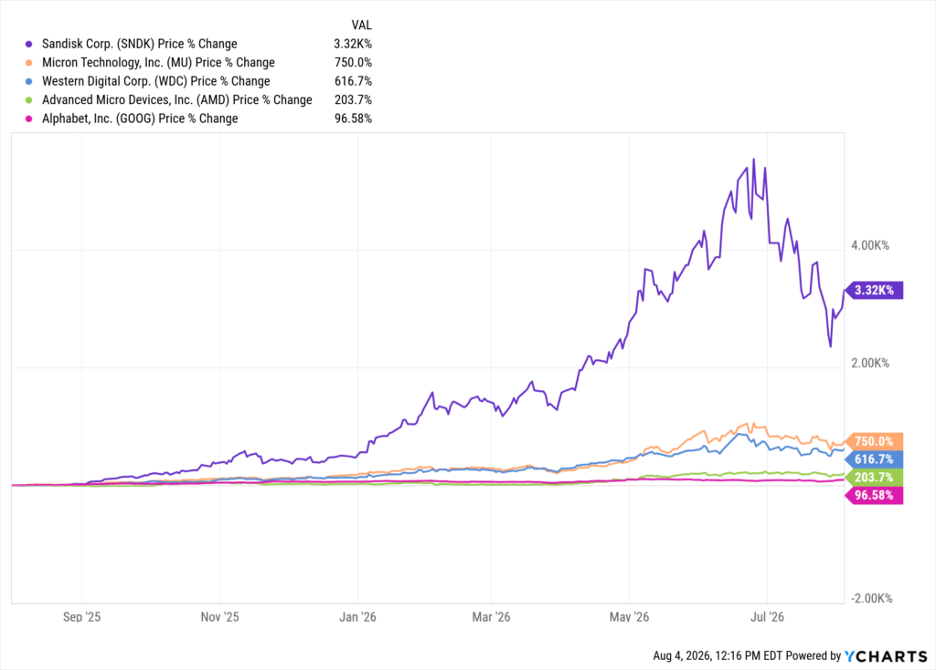
However, as the chart above illustrates, a stock that rises rapidly can also decline just as quickly. After its extraordinary advance, Sandisk’s share price fell 56.5% over about five weeks, from June 25 through July 29, 2026. The July 29 close of $1,015.89 per share so far appears to be the low, as the stock rebounded 26% in the very next session.
There are many factors to consider when deciding to hold or sell strong-performing stocks. Regarding a pure investment decision, the deciding factors may include:
- A rising price-to-earnings (P/E) ratio based on forward earnings
- Any change in institutional analyst support for the stock’s future growth
- Daily trading volume, and whether the heavier volume days come on advances or declines
- Commentary on the company’s products and whether it can sustain the robust growth of new orders and sales
However, the decision to sell some or all of a highly appreciated stock may not entirely be based on your forecast of its future stock appreciation potential. Ideally, you want to incorporate a selling strategy while the stock price is still in a positive trend. You may want to reduce its high allocation because your appreciated account value will allow you to achieve your long-term financial goals and a sudden drop in price will have too great of an impact on your account. This is when a well-defined financial plan with cash flow projections can be referenced to determine the selling strategy to rebalance your account to a desired risk level.
As for how, the goal is to reduce the position deliberately rather than all at once. Common approaches include selling in stages over several quarters or across two tax years to spread out the capital gains, choosing which specific tax lots to sell so that higher-cost shares go first, and setting a rebalancing band, such as trimming whenever the position exceeds a set percentage of the account, so the decision becomes a rule instead of a judgment call each time. For charitably inclined investors, gifting appreciated shares directly to a charity or donor-advised fund can reduce the concentration without triggering the capital gain. The right combination depends on your tax situation and financial plan, which is a conversation we welcome having with you.
What does this mean to me?
Our Weekly Update, “Summer Sale is On,” addressed the consistent underperformance of the S&P 500 during the third quarter, stating:
“The chart below illustrates the average quarterly performance of the S&P 500 since 1928. While the third quarter has historically produced the smallest gains, it has often served as a period of consolidation before stronger fourth-quarter advances. In fact, the average Q4 gain has historically been nearly twice that of Q3.
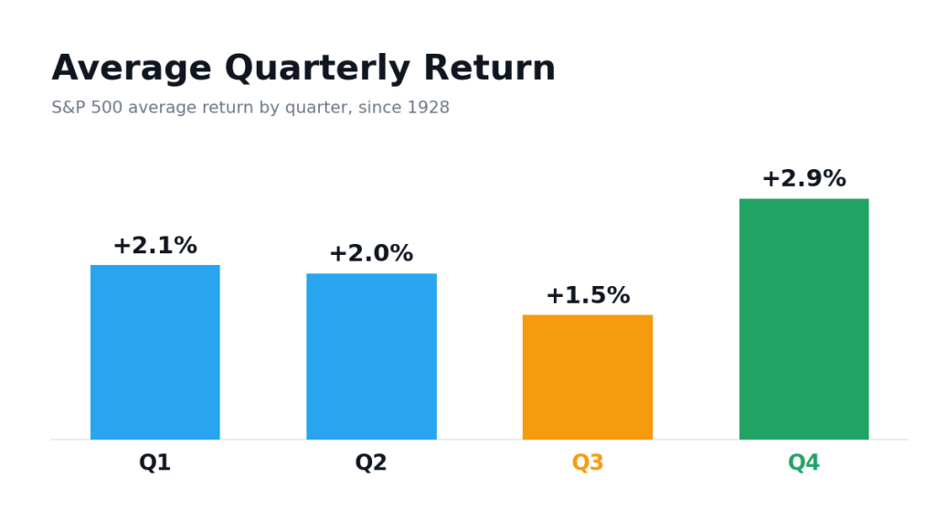
The average annual contribution by each quarter is more revealing. Since WWII, the average contribution to the year’s gain by quarter was best achieved during the 4th quarter, which on average is responsible for 45% of the year’s gain. While the third quarter contributes only 6% of the year’s gain. Below is a chart of how much the year’s total return is earned during each quarter. Data via Bespoke Investment Group.”
So far, history is repeating itself this year. Between June 2 and late July 2026, the positive trend in major US and international indices stalled, with several falling below their earlier highs for the year, before the S&P 500 returned to record closing highs in early August. In our opinion, the fundamentals of the US economy, the stock market, and the technology sector remain favorable. Flat third-quarter trading has at times preceded stronger fourth quarters, though historical seasonal patterns do not indicate what will happen this year.
Let us know if you have any questions about this Update. We welcome the opportunity to discuss your financial goals and objectives with you and determine how we may assist you and your family in achieving them.