
President John F. Kennedy popularized the phrase ‘A rising tide lifts all boats’ in the early 1960s, a simple image for how broad economic growth carries everyone with it. The expression has since become a popular metaphor for periods of economic expansion when favorable conditions help support growth across many sectors of the economy.
There are many ways to describe a positive economic environment. In aviation, one analogy we often use when discussing strong stock market trends is the concept of tailwinds. Just as a tailwind allows an aircraft to travel faster while maintaining the same engine RPM, favorable economic conditions can help propel corporate earnings and stock prices higher with less resistance.
Warren Buffett later offered a cautionary counterpart when he famously observed, “Only when the tide goes out do you discover who’s been swimming naked.” Together, these two observations provide an important lesson for investors. Strong economic conditions and bull markets can lift many investments, but periods of market weakness often reveal which companies possess durable earnings, strong balance sheets, and sustainable business models. I will address that downside perspective later.
For now, investors have been focused on the remarkable debut of SpaceX (SPCX), which has captured both headlines and Wall Street’s attention. Last Friday, SPCX was priced to open at $135/share and began trading on the NASDAQ at $150/share. On Friday, investors rallied behind SPCX that delivered a spectacular first day performance, gaining 19.22%. The “lift-off” continued this week, with shares advancing 49.07% from Friday’s opening trade through today closing at $201.24.

But momentum and durability are not the same thing, and that distinction is where the year gets interesting. The challenge for investors is determining which opportunities have the earnings growth, financial strength, and institutional support necessary to sustain their ascent long after the initial excitement fades.
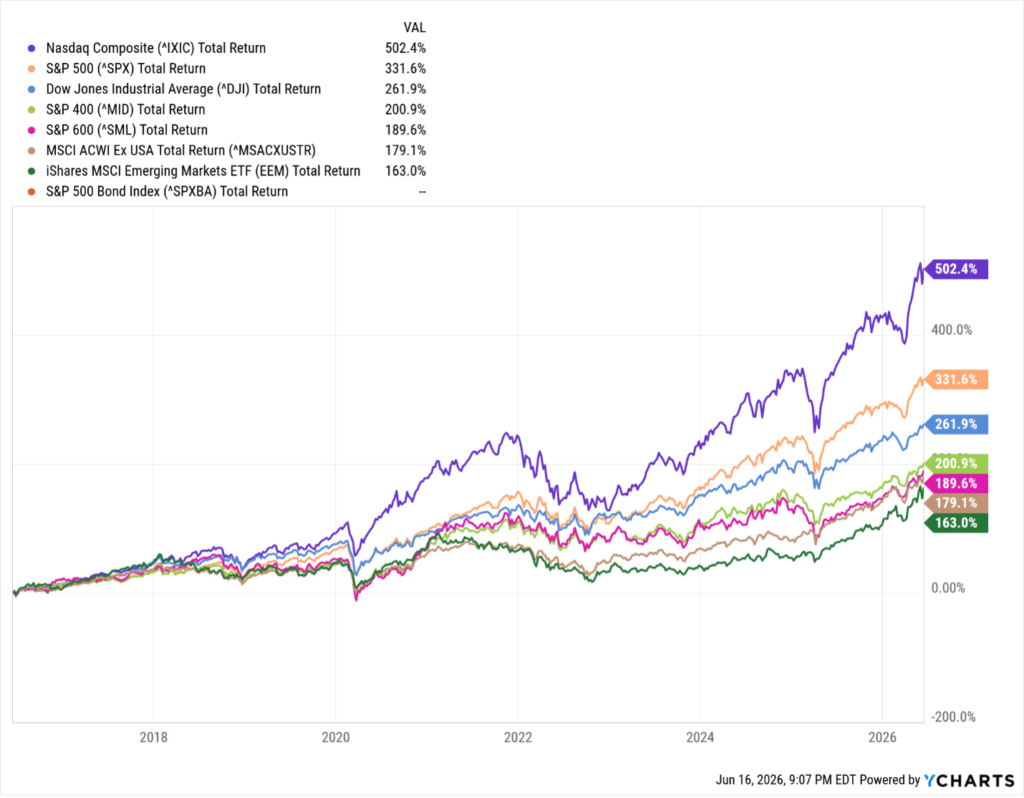
The best performing US major stock index YTD is not NASDAQ but the S&P 600 Small Cap index. The S&P 600 is up 19.76% YTD while NASDAQ is up a mere 15.15% with the S&P 500 trailing with a YTD return of 10.98%. This is the investor rotation we have been forecasting in recent UPdates, as a sector that has trailed the S&P 500 and NASDAQ since 2017 is now leading the major U.S. stock indices. The shift suggests investors are broadening their participation beyond large-cap technology stocks and seeking opportunities in areas of the market that have lagged for years.
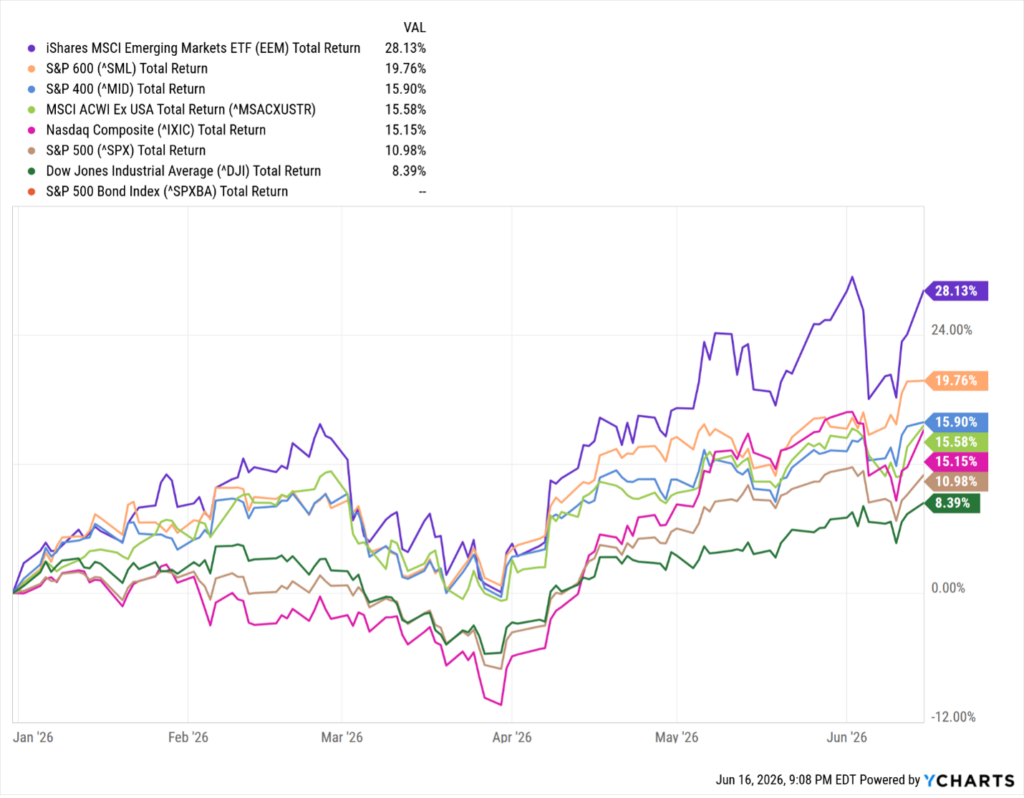
However, the Emerging Market Index (EEM) is the best performing benchmark of major indices. This index is up 28.13% YTD and also a sector that has trailed NASDAQ and the S&P 500 since 2017. In fact, EEM has the worst 10-year return of any index here, which makes its sudden leadership all the more striking. Investors appear to be diversifying to lower priced stocks in foreign markets with the renewed demand driving up emerging market stock prices.
Nonetheless, all the major stock US indices have benefited from the strong debut of SPCX, helping to reinforce the positive momentum already present in growth-oriented stocks. On the chart below I marked June 10 that is turning into a new pivot point of renewed investor buying of stocks.
Contributing to these favorable tailwinds are recent developments in the Middle East. Investors have responded positively to reports that a peace agreement involving Iran is expected to be signed this Friday. As optimism surrounding a resolution to the conflict has increased along with the toll-free opening of the Strait of Hormuz. Oil prices have been trending lower in recent weeks as markets anticipate a reduction in geopolitical risk and the continued flow of commerce through the Strait of Hormuz. West Texas Intermediate Crude traded below $80 per barrel for the first time since the Iran crisis began.
President Trump is scheduled to meet with leaders of Iran on Friday to formalize the agreement. Should the treaty be successfully executed and honored, it could remove a significant source of uncertainty that has weighed on global markets throughout the year.
Meanwhile, Kevin Warsh, the newly appointed Chairman of the Federal Reserve, has advocated for a more disciplined approach of messaging by members of the Federal Open Market Committee (FOMC). Warsh has expressed the view that the Federal Reserve “talks too much” and that excessive commentary by central bankers can unnecessarily influence investor behavior and contribute to short-term market volatility. His preference is for policymakers to communicate less frequently and allow economic data and policy decisions to speak for themselves.
Consumer spending is the primary engine of the U.S. economy, accounting for approximately 66% of Gross Domestic Product (GDP), making the attitudes and confidence of consumers a critical component of future economic growth. Lower energy prices and gas prices at the pump will slow down inflation and further improve consumer sentiment as high gas prices were one concern cited in recent surveys.
Here is the puzzle of this cycle. Consumers say they feel worse than at almost any point since the University of Michigan began tracking sentiment in 1972, yet they keep spending. This disconnect between how consumers feel and how they continue to spend has been a defining characteristic of the current economic cycle.
Investors would likely view a sustained improvement in consumer sentiment as a positive development, signaling increased confidence in personal finances, employment prospects, and the broader economy. Such a shift could support stronger consumer spending in the months ahead and improve expectations for a robust holiday shopping season, which is a critical period for many retailers and consumer-oriented businesses.
Taken together, easing geopolitical tensions, declining energy prices, a more predictable Federal Reserve, and the potential for improving consumer confidence could provide additional support for the economy and financial markets. While volatility is always a normal part of investing, these developments may help reduce market turbulence during the historically low performing third quarter. Most importantly, possibly encourage investors to maintain or increase their allocations to equities as they position for continued economic expansion and strong year end rally.
What Does This Mean to Me?
The combination of a rising tide, favorable tailwinds, and renewed investor enthusiasm suggests that the current Growth/Expansion cycle remains intact. Economic growth, easing geopolitical tensions, lower energy prices, improving market breadth, and a potentially less disruptive Federal Reserve are creating an environment that continues to support corporate earnings and stock prices.
Importantly, leadership within the stock market appears to be broadening. While technology and AI-related companies continue to attract attention, the strong performance of the Emerging Markets and S&P 600 Small Cap Index indicates that investors are increasingly finding opportunities beyond the tech companies. Historically, broad participation across multiple sectors and market capitalizations has been a healthy characteristic of durable bull markets.
At the same time, investors should remember that not all boats rise equally. Positive economic conditions can lift most stocks, but over the long term, the market tends to reward companies that consistently grow sales, expand profits, strengthen their balance sheets, and attract institutional investment. Periods of optimism often create opportunities, but they can also encourage speculation and excessive risk-taking.
We continue to maintain a favorable outlook on the U.S. economy and stock market. The recent improvement in market conditions may help reduce volatility during the third quarter and support additional gains as investors position for year-end. A meaningful improvement in consumer sentiment would further strengthen our outlook as consumer spending increases, which remains the primary driver of economic growth.
As always, our focus remains on identifying companies, sectors, and industries demonstrating sustainable positive momentum supported by rising sales, earnings growth, and institutional demand. While short-term headlines often dominate the news cycle, successful investing is built on recognizing long-term trends and remaining disciplined through both periods of optimism and uncertainty.
For long-term investors, the message remains clear: stay focused on quality, maintain diversification, and allow the powerful forces of economic growth, innovation, and compounding returns to work in your favor over time.
Give us a call if you would like to discuss in depth strategies that may be appropriate to accomplish your goals. We strive each day to assist our clients in achieving their financial and personal goals and celebrate together their “wins” along the way.